
How We Reimagined a 1930s Living Room After Almost 20 Years
Updated: Aug 12
Sometimes the hardest thing about changing a room is being able to imagine it looking any different at all.
When a space has looked almost the same for years, particularly a room you have lived with every day, it can become surprisingly difficult to separate what the room is from what the room could be.
That was exactly the challenge here. This living room had not been properly redecorated in almost 20 years. The children had grown up and flown the nest, the way the house was being used had changed, and the room needed a new purpose: somewhere for coffee mornings with friends, listening to music and simply enjoying the house again.
The only real design instruction was simple: keep it in keeping with the 1930s house.
The starting point: a room that had stopped evolving
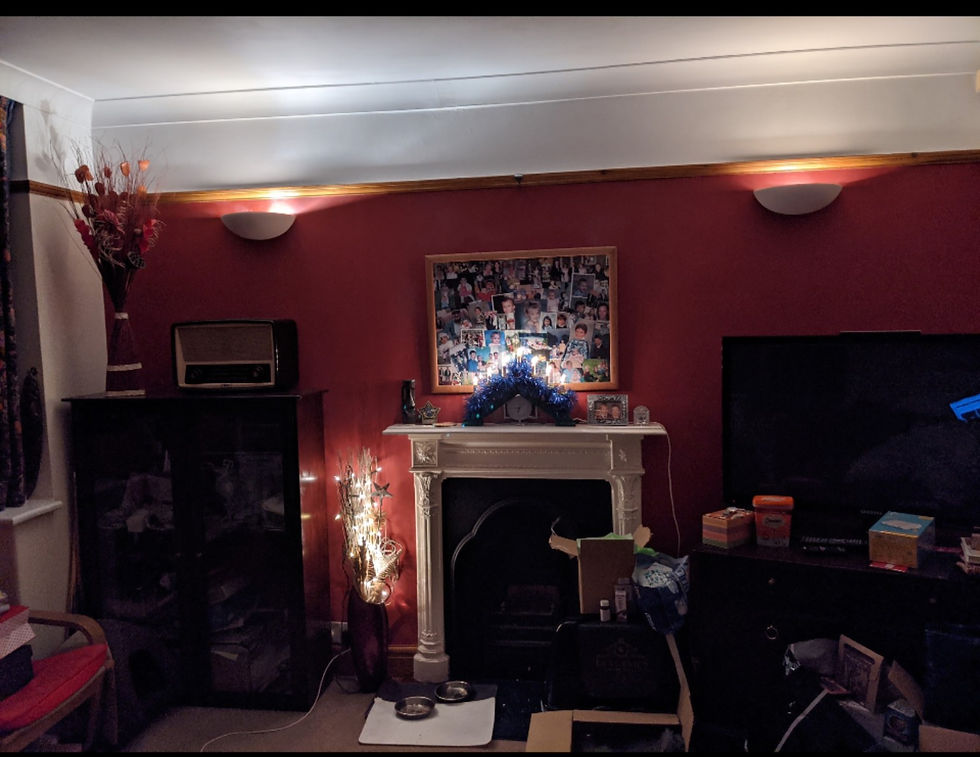
The original room had good bones: a beautiful fireplace, generous proportions and the character you expect from a period property. But years of accumulated furniture, a deep red wall colour and a layout that had evolved around family life meant it felt heavier and more enclosed than it needed to.
Nothing was necessarily wrong with it. The house and the people living in it had simply moved on. The goal was not to strip away the 1930s character, but to reveal it again.
Removing one period detail to bring back another
One of the existing features was the picture rail. Normally we love original detailing, but this family are tall and, in this particular room, the rail visually lowered the eyeline and made the ceiling feel closer.
We suggested removing it, then bringing character back through wall beading and moulding. That redistributed the detail across the walls, making the room feel taller, cleaner and more intentional without losing its period identity.
Respecting a period property does not mean preserving every previous decision.
Creating a lighter room without losing personality
The deep red walls gave the room warmth, but they also absorbed a lot of light. A much lighter wall colour immediately changed the balance: the fireplace became more prominent, the new moulding could cast subtle shadows, and the furniture had room to stand out.
The important thing was avoiding the opposite problem, making everything pale and losing the personality. That is where blue became the anchor.
The mood board: grounding the idea in real choices

The mood board brought together the ingredients of the room: a rich blue sofa, soft grey armchair, textured curtains, warm timber, pale neutral walls, black, brass and a little greenery.
The blue sofa gives the scheme depth and makes the room feel special without dominating it. Against the lighter background, it creates a balance that feels light but not bland, traditional but not old-fashioned, and comfortable without becoming generic.
A rug that makes the room feel cosier and bigger
The rug had two jobs. It needed to pull the seating together and make the room comfortable for long conversations and coffee mornings, while also helping the space feel larger. Choosing a generously sized rug meant the eye could read the seating as one calm, connected zone rather than lots of separate pieces.
Bringing the house back to the 1930s through lighting
Lighting was another opportunity to quietly reconnect the scheme with the age of the house. Globe wall lights and a geometric ceiling fitting bring in a subtle 1930s influence through shape, brass and symmetry, without making the room look like a reproduction set.
The aim was not to recreate 1935. It was to make the room feel as though it had evolved naturally from the house it belongs to.
Where AI changed the conversation

For more traditional clients, a mood board is incredibly useful. It makes the decisions tangible: you can see fabrics together, compare texture and understand how timber, metal and colour relate.
But a mood board still asks somebody to make one big mental leap. It cannot fully show them their room.
This was where AI visualisation became unexpectedly powerful. We took the design decisions already made, furniture, colours, wall detailing, lighting and overall direction, and brought them to life within the proportions of the space.
Suddenly the clients were not looking at separate fabric samples and furniture images. They could see the possibility: their fireplace, their room and their proportions, transformed.
The mood board explains the ingredients. AI helps show what those ingredients might become.
Struggling to visualise changes in your own home? M&M can create a considered mood board and photorealistic room concept to help you explore a new direction before you start buying, decorating or making bigger decisions. Get in touch and tell us about your room.
Designing for how the room is used now
For years, homes naturally adapt around children. Furniture moves, storage arrives and rooms become multipurpose. Then family life changes, and sometimes the house needs permission to change with it.
For this couple, the living room could finally become somewhere centred around them: coffee with friends, music, conversation and comfort. That led us towards a simpler furniture layout, proper seating and less visual clutter.
Sometimes a room does not need changing because there is something wrong with it. It needs changing because life around it has changed.
Can’t quite see what your room could become?
Sometimes you know a room needs to change, but you cannot quite picture what should come next. Maybe it has not been decorated for years. Perhaps your family has changed, the way you use the space has changed, or you simply know it no longer feels like you.
That is where we can help.
At M&M Digital Services, we can take the room you already have and help you explore what it could become, combining a considered interior concept, mood board and photorealistic AI visualisation so you can see the possibilities before committing to decorating, furniture or bigger purchases.
We work with the character of your home, how you actually want to use the room and the things worth keeping. Then we bring the new direction to life so you are not being asked to make expensive decisions based on a fabric swatch and imagination alone.
You do not need to know exactly what you want before getting in touch. Sometimes all you need to know is: this room is not working for us anymore.
Ready to reimagine a room?
If you have a living room, bedroom, home office or another space you have struggled to see differently, get in touch with M&M and tell us about it. We would love to help you see what is possible.
See More Before & After Transformations
If you love seeing what a room can become, we have saved more of our before-and-after transformations on Pinterest. Save your favourites for inspiration and start thinking about what might be possible in your own home.


Comments