Marketing Isn’t Just for Businesses: Why the Best Events Feel Like a Brand
When most people hear the word marketing, they think of businesses: logos, websites, social media, advertising and campaigns. But strip marketing back to what it actually does and the principles are much broader.
It is about understanding who something is for, creating an idea people can recognise, building anticipation, keeping everything connected and designing an experience people remember afterwards.
Which, when you think about it, sounds remarkably similar to planning a really good party. A wedding. A first birthday. A gender reveal. A milestone celebration. Or simply an excuse to get your favourite people into the same room.
At M&M, we spend a lot of time helping businesses create identities and campaigns that feel joined up. But those same creative skills can be used for something much more personal. Because sometimes you don't need a brand. You just want your event to feel brilliantly thought through.
A Theme Is Really a Tiny Brand
Think about what happens when you create a brand for a business. You choose a visual direction, colours, typography, tone of voice, imagery and a central idea. Then you repeat those ingredients consistently wherever somebody encounters the business.
An event works in almost exactly the same way. Perhaps the idea begins with bees. Or a television programme. A pun around somebody's name. A favourite colour. A film. An era. Or something completely ridiculous that only your family understands.
Once you've found the idea, the question becomes: how do we carry it through the whole event without making everything feel mismatched? The invitation sets the expectation. The signage reinforces it. The games make it interactive. The table details continue the story. The banner creates a focal point. Even the wording can belong to the same world.
That is essentially brand consistency. Just with more cake.
The Hard Part Isn't Usually Having the Idea
Most people are not short of ideas for their own celebrations. The difficult bit is turning them into one cohesive event.
You find an invitation you like, then a game from somewhere else, a welcome sign in a different style, a banner from another supplier and some printable cards created late at night three days before the party. Individually, everything can be lovely. Together, it can feel like five separate parties happened at once.
For businesses, we'd call that a brand identity problem. For your party, we might just call it making everything feel like it belongs together.
A Pre-Wedding Icebreaker That Became an Event of Its Own

One of our favourite examples came from a wedding — although the game actually took place the evening before. The couple wanted to give guests something to do together before the wedding day itself. People were arriving from different parts of their lives: some knew each other really well, while others had barely met.
So the challenge wasn't simply what entertainment to put on. It was how to give people a reason to interact naturally and get to know one another before the wedding.
The couple also love strategy games, and at the time The Traitors was everywhere. That made the idea immediately relevant to the guests while also feeling genuinely suited to the bride and groom. Then there was the venue: it had a library. Sometimes an idea almost designs itself.
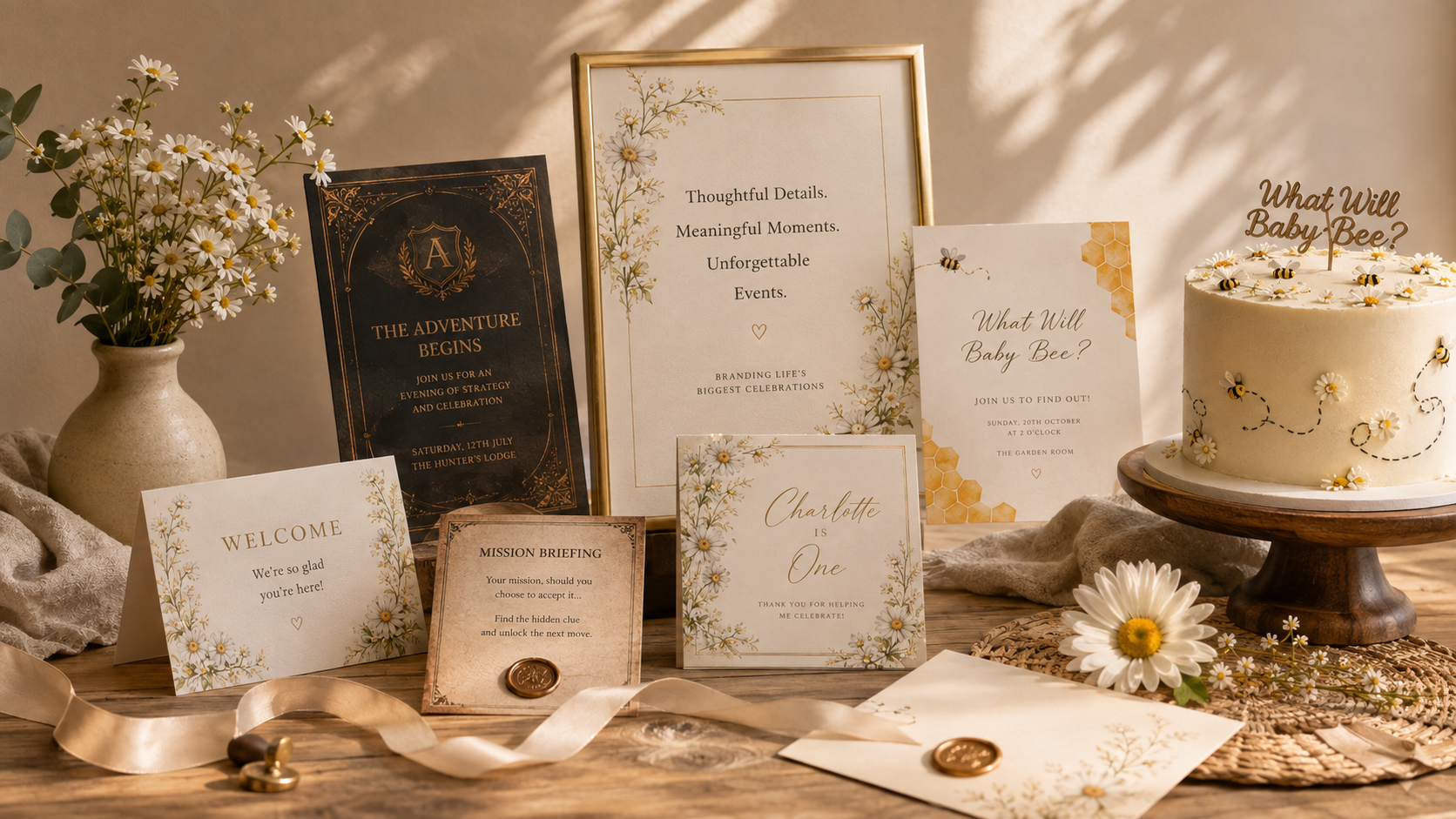
We created a Traitors-inspired wedding-eve game that ran throughout the evening. There was a rule book, teams, missions, shields, murder scrolls, banishment cards, a themed team plan, prize cards and activities for the children too.
The intention wasn't simply to recreate a television programme. It was to take a format people already understood and adapt it around this particular couple, their guests and the reason everybody was together.
That is what made it work as an icebreaker. Guests suddenly had a reason to speak to people they didn't know. Teams had to work together. People started accusing each other. Conversations happened naturally. And because the couple genuinely love strategy games, it felt like an extension of their personalities rather than entertainment added simply to fill an evening.
The library setting made the whole thing even better. The darker, traditional surroundings naturally suited the intrigue and drama of the game, so the physical venue became part of the experience too.
And That's Very Similar to Good Marketing
The audience already understood the cultural reference. The timing made it relevant. The concept reflected the couple themselves. The purpose was clear: help guests mix and get to know one another. The environment supported the idea. And the creative assets made all of those different elements feel like one experience.
For a business, we'd call that understanding your audience, choosing a relevant creative idea and delivering it consistently across every touchpoint. For a wedding, it meant putting friends and relatives into teams and encouraging them to become deeply suspicious of one another the night before the ceremony. Both require surprisingly similar thinking.
“What Will Baby Bee?” — Taking One Idea Further

A gender reveal can easily become a collection of blue and pink decorations. But sometimes a simple creative idea gives you something much more distinctive to build around.
For one celebration, that starting point was: What Will Baby Bee? A bee-inspired theme gave the event an identity from the beginning.
The idea carried through the invitation, the Find the Guest bingo game, old wives' tales predictions, the decorations and even the cake. The honeycomb shapes, bees, warm yellow details and playful wording meant the different elements all felt connected without needing to be identical.
The benefit of developing the identity before creating all the separate pieces is that every new asset becomes easier. You're no longer asking, “What should this sign look like?” You're asking, “What does this sign look like in our Baby Bee theme?” It sounds like a small distinction, but creatively it makes a huge difference.
Charlotte Is Onederful — When One Detail Ties Everything Together

For Charlotte's first birthday, the starting point was the phrase Charlotte Is Onederful. But the thing that really made the event feel cohesive was the daisy theme.
The daisies carried across the welcome sign and birthday assets, then continued into the physical styling of the celebration — even the cakes picked up the same motif.
That is exactly the kind of detail that makes an event feel considered. The individual pieces do not all need to be identical. They just need something recognisable that connects them. In this case, that was the daisy.
It is essentially the same principle we use when creating a brand system for a business: choose a few distinctive ingredients and repeat them consistently enough that people begin to recognise the look. Because the theme carried through into the cakes and physical details as well as the printed assets, the result felt like one complete event rather than a collection of separate decorations.
Why Consistency Matters at Personal Events Too
Nobody is going to leave a birthday party and say, “Excellent application of brand governance.” At least we hope not. But people absolutely notice when something feels considered.
The invitation looked like the sign at the entrance. The menu cards matched the table. The games belonged to the theme. The little details felt intentional. That creates a subtle sense that somebody has thought about the whole experience.
Businesses use exactly the same principle. If a website feels completely different from the company's social media, which feels completely different from its presentation deck, something feels off. An event can have the same problem — except families are often solving it while simultaneously ordering balloons, checking dietary requirements and wondering whether anyone remembered to buy ice.
Personalised Party Games Are Where Things Get Really Fun
Traditional party games can be brilliant. But once you personalise them around the people at the event, they become much more memorable.
For a wedding weekend, that might mean creating an entire strategy game around the couple and their guests. For a birthday, it could be personalised bingo, trivia, scavenger hunts or challenges. For a baby shower or gender reveal, it might be predictions, parent trivia, old wives' tales or games designed around the theme.
The creative direction can be elegant, funny, completely ridiculous or somewhere in between. The important thing is that it feels as though the game was created for this particular group of people rather than downloaded five minutes before everyone arrived.
You Don't Need to Spend Weeks Designing It Yourself
Most people could create all of this given enough time. But event planning already comes with a remarkably long list of jobs: venue, food, guests, decorations, music, timings, suppliers, parking and all the small practical decisions nobody sees.
Creative assets are usually the part people enjoy imagining but struggle to find the time to actually produce. That's where we can step in.
We Can Do the Thinking — So You Can Enjoy the Event
At M&M, we can help take an idea and turn it into a complete visual direction for your event. That might mean one personalised invitation, or it might become an entire suite of matching assets: invitations, save-the-dates, signage, welcome boards, table plans, menus, place cards, party games, wedding activities. Themes, baby showers, gender reveals, digital graphics and print-ready artwork.
Where physical production is needed, we can also work with suppliers to help bring the pieces together. The point isn't that every party needs fifty personalised items. It doesn't. The point is that whatever you do create should feel connected. Sometimes three really good pieces are far more effective than twenty unrelated ones.
The Same Thinking. A Much More Personal Outcome.
Marketing and event design might sound like two completely different worlds. But the underlying creative thinking is surprisingly similar: Who is this for? What do we want them to feel? What's the central idea? How should it look? How should it sound? Where will people interact with it? How do we make all those moments feel connected?
For a business, those questions might create a brand campaign. For a wedding weekend, they might create a library full of missions, murders and increasingly suspicious relatives. For a gender reveal, they might create an entire world around a little bee. For a first birthday, they might turn one excellent pun and a daisy into the theme for the whole day.
Different occasion. Same creative muscles.
Planning Something Personal?
If you have an event coming up and an idea you want to make feel more special, we'd love to hear it. You don't need a finished theme or a colour palette. Tell us what you're celebrating, who it's for and any ideas already floating around.
We'll help with the thinking, create the assets and help bring the details together — so you can spend more time enjoying the event itself.
Because marketing doesn't always have to be about selling something. Sometimes it's simply about creating a moment people remember.


Comments