Two Dyslexic Founders, One Clear Approach: How Dyslexia Shapes M&M Digital Services
Being dyslexic has shaped more of M&M Digital Services than people might realise.
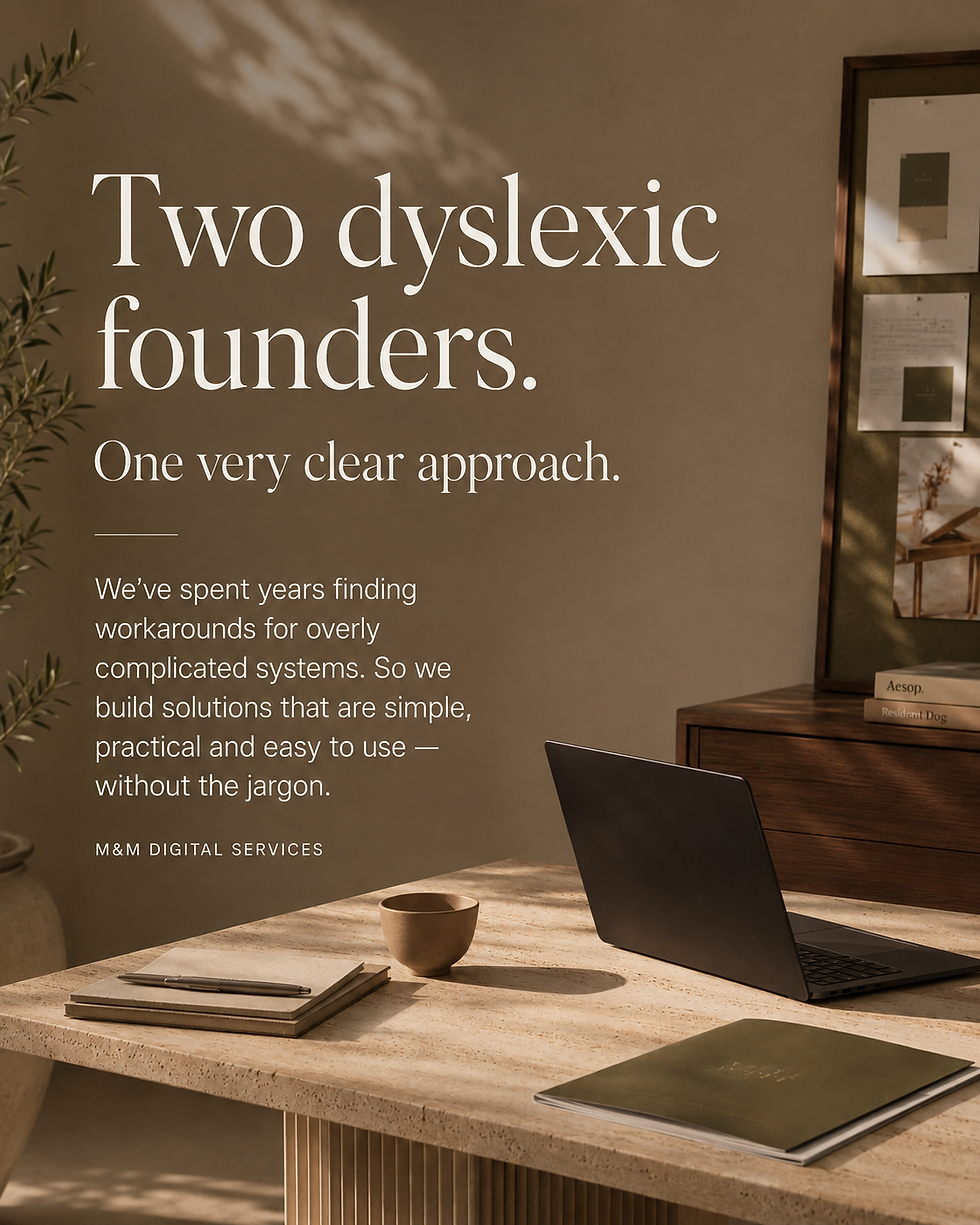
For both of us, it has meant learning to navigate information, systems and ideas in ways that make sense to our own brains. Over time, those workarounds have become part of how we think about good design: if something is too complicated, too jargon-heavy or too difficult to follow, there is probably a clearer way to do it.
Mark: patterns before the problem is obvious
Mark’s dyslexia has always shown up strongly in the way he works with numbers, data and patterns. He can often see relationships, anomalies and emerging themes before most people have even noticed there is something to look for.
That ability has naturally fed into his work across data science, architecture, AI and technology. Rather than accepting a process because ‘that’s just how it works’, he tends to pull it apart, understand what is really happening underneath and look for the simpler route.
It is one of the reasons our Digital Product & Technology approach is so focused on removing unnecessary steps, connecting the right tools and designing systems around the people who actually have to use them.

Michelle: seeing the idea before finding the words
Michelle’s dyslexia shows up differently. Her strength is often in imagination and visualisation: seeing the finished idea, the look, the feeling or the direction before it has been translated into a neat brief.
The harder part can be turning that very clear picture in her head into the exact words needed to explain it. That is where AI has genuinely changed the game.
AI has become more than a business productivity tool. It can help turn rough thoughts into structure, translate a visual idea into usable language, organise information and bridge the gap between knowing what you mean and being able to articulate it quickly.

AI is useful for business, but for us it has also been useful in helping with some of the very practical traits that come with dyslexia.
Why that matters to the way we work
Neither of us has much patience for complexity that exists for its own sake. If a process needs a glossary, five handoffs and a 30-page explanation before someone can use it, we are going to ask whether it can be simpler.
That does not mean removing depth. It means doing the hard thinking behind the scenes so the experience for the person using the product, service or system feels straightforward.
Clear language instead of unnecessary jargon
Fewer steps where fewer steps will do
Visual thinking where a diagram explains more than a page of copy
Automation where it removes repetitive work rather than adding another tool
Technology designed around people, not people forced to work around technology
AI as an accessibility tool as well as a business tool
There is a lot of conversation about AI saving time, creating content and automating work. All of that is useful. But one of the most interesting parts for us has been how it can make certain kinds of work more accessible.
It can help organise a messy thought, offer another way to phrase something, summarise a dense piece of information or give someone a starting point when the blank page is the hardest part.
Used well, it does not replace the thinking. It helps remove some of the friction between the thinking and the output.
Clarity is part of the philosophy
Our experiences with dyslexia are different, but they have led us to a very similar place: we value clarity.
We want the things we design to feel useful, understandable and human. Whether that is a data architecture, an automation, a marketing plan, an AI workflow or a visual concept, the aim is the same: make something complex easier to work with.
Because clarity is not a lack of sophistication. Quite often, it is the result of doing the complicated thinking properly.
If your business has a process, system or idea that feels harder to explain or use than it should, that is exactly the kind of problem M&M Digital Services likes to untangle.


Comments